| |
| |
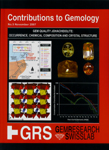
GEM
QUALITY JOHACHIDOLITE:
OCCURRENCE,
CHEMICAL COMPOSTION AND CRYSTAL STRUCTURE
Adolf Peretti (1), Francesca Perettl (1), Ngwe Lin Tun (1),
Detlef GUnther (2), Kathrln Hametner (2),
Willy Bierl (3), Eric Reusser (4), Mllen Kadlyskl (5), Thomas
Armbruster (5)
(1) GRS Gernresearch Swisslab Ltd, Sempacherstr 1, CH-6003
Lucerne, Switzerland
(2) Laboratory of Inorganic Chemistry ETH Honggerberg, HCI,
G113, CH—8093 Zurich, Switzerland
(3) GRS (Thailand) CO LTD, Bangkok, 10500 Thailand
(4) Institute of Mineralogy and Petrography C/ausiusstr 25,
ETH Zentrum, CH—8092 Zurich, Switzerland
(5) ll/liner Ciystallogr, Institute of Geological Sciences,
University of Berne, Freiestr 3, CH-3012 Berne, Switzerland |
|
INTRODUCTION
The mineral was first described, though with a wrong
chemical formula, from the Johachidolite District,
Kisshu County, Kankyo I-lodu Perfecture, North Korea,
and was named after the type locality. Aristarain
and Erd (1977) assumed that the originally postulated
composition of johachidolite H6Na2Ca3Al4F5B6O2O
(lwase and Saito, 1942) is due to intimate intergrowth
of two different minerals, one F-rich and the other
johachidolite of CaAlB3O7composition.
The newly proposed formula and redefinition of the
mineral is based on electron microprobe analyses of
the metatype specimen showing major Ca and AI only
(Aristarain and Erd, 1977) and a single-crystal X-ray
study performed on the same material by Moore and
Araki (1972). The latter authors showed that johachidolite
possesses an unusual layer structure in which BO4)
tetrahedra are assembled to form corrugated sheets
linked by octahedral Al and ten-fold coordinated Ca.
ln 2001, an article appeared with the title "johachido|ite
- a new gem" (Harding et al., 1999) featuring
the worlds first and only gem quality johachidollte
of 14.02 ct. The authors conclude that the gem is
probably natural, with a possible source in the Mogok
area of Myanmar.
In this work, we were able to trace the origin of
the material to the exact mine, collect and analyze
rock samples containing johachidolite, present pictures
of johachidolite in matrix, determine the chemical
composition of johachidolite, restudy the crystal
structure of johachidolite using state of the art
equipment (See also Kadiyski et al., in prep.), present
more gem quality johachidolite specimens (Worlds No.
2, 3, 4 etc.), present data on the chemical composition
of the first published johachidolite of 14.02 ct and
prove its natural origin.
The chance that new gems may be
found in the area of Mogok is quite likely because
of extensive mining over an area of about 600 km2.
According to the estimation of one of the authors
(NLT) who lives permanently in Mogok, a huge number
of up to four hundred thousand miners work day and
night. Once a rare gem is found and identified, however,
it is very difficult to trace it to the exact spot
of discovery. Direct expeditions to miners are therefore
the only possibility |
|
to
locate the occurrence of new gems. The mining
area, however, is closed for foreigners since
2004 and even when visitors were permitted to
visit the area, many mines were government controlled
and inaccessible. Between 1999 and 2002, one
of the authors (AP) was permitted to explore
the mines at Mogok and was able to spend a total
of about three weeks in the field. Among important
information on the occurrence of rubies, sapphires
and spinels in this area, it lead to the discovery
of painite (Armbruster et al., 2004). During
the trips to the Eastern part of Mogok, special
attention was paid to the mining areas of Pain
Pyit and Chaung Gyi. These mines are normally
inaccessible to visitors but permission was
granted in 2002 (Fig. ..J11-J15). The area of
Pain Pyit,
which is known as Fyant Gyi was of special interest
(Fig. J02). This area is known for the occurrence
of various gems, such as other borates including
danburite and poudretteite, as presented in
Tab. J01.
One of the authors (NLT) had the possibility
to test gemstones in l\/logok for GRS over a
period of several years, which lead to the discovery
of faceted johachidolite and eventually the
exact spot of occurrence.
|
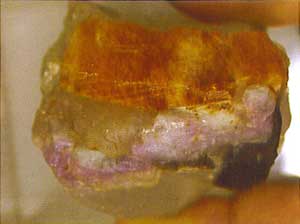 |
Fig.J01
A specimen with a 40mm long johachidolite crystal
associated with hackmanite on matrix. GRSW collection.
Origin: Pyant Gyi Mine, (EAstern Mogok, Burma,
Myanmar). |
|
|
|
|
|
|