| |
IGJ Thailand - Bangkok's Mid-Year Fair Gets Positive Response from Industry |
|
| |
|
The initial announcement of the International Gems & Jewellery Thailand Fair 2013 has drawn much favourable response from prospective exhibitors, both in Thailand and abroad. |
|
|
|
|
|
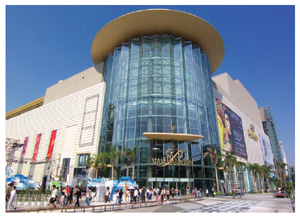
Thailand’s only mid-year
gems and jewellery trade event,
the International Gems & Jewelry
Thailand Fair 2013 (IGJ Thailand)
will be held between 13-16 June
2013 at the Royal Paragon Hall
Exhibition & Convention Center
in Bangkok.
Located in the heart of
downtown Bangkok, within the upmarket
Siam Paragon megashopping
mall, the Royal Paragon
Hall brings a new dimension to gem
and jewellery trade shows in
Bangkok |
|
The city-central location
means the venue is easily accessible
by car, cab or sky-train.
And being situated in
Bangkok’s most exclusive and highend
mega-shopping mall, the IGJ
Thailand Fair can be accessed by
discerning retail shoppers – those
shoppers who appreciate quality
jewellery, and who are accustomed
to selecting and purchasing fine
jewellery and gemstones.
IGJ Thailand 2013 will offer
exhibitors the complete range of
exhibit categories, in jewellery, gemstones, equipment and services. |
|
 The International Gems &
Jewelry Thailand 2013 Fair is being
marketed by BG&J Group,
publishers of Bangkok Gems &
Jewellery Magazine. BG&J brings
to this event considerable
experience in this particular field.
BG&J was instrumental in
establishing the tradition of an
annual Bangkok mid-year gem and
jewellery event, which was widely
acclaimed by the Thai gem and
jewellery industry. The International Gems &
Jewelry Thailand 2013 Fair is being
marketed by BG&J Group,
publishers of Bangkok Gems &
Jewellery Magazine. BG&J brings
to this event considerable
experience in this particular field.
BG&J was instrumental in
establishing the tradition of an
annual Bangkok mid-year gem and
jewellery event, which was widely
acclaimed by the Thai gem and
jewellery industry.
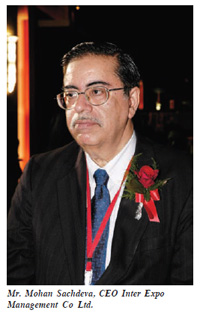
IGJ Thailand 2013 is being
organized and managed by Inter
Expo Management Co Ltd, a joint
venture of Tong Hua
Communication PCL and BG&J Co
Ltd. |
|
|
| |
|
|
| |
Speculation Threatens Diamond Industry
By Moti Ganz |
|
| x |
As president of the
International Diamond
Manufacturers Association, I
would like to express the pain
and shout out in the name of
all the diamond manufacturers
the world over. This is one in
a series of articles and
speeches in which I have tried
to persuade the rough
producers that today’s profit
is tomorrow’s loss.
Speculation has died — I shout in their ears. Soon there
won’t be any more manufacturers with factories and
obligations to employees and commitments to rough
suppliers. And then what will you do with the rough?
Until now all my calls have been like a voice in the
wilderness. Everyone understood exactly what I was
talking about but it was more comfortable for them to
put their hands over their eyes, ears and mouth —
knowing nothing, seeing nothing, hearing nothing —
especially as the cash register kept ringing. So that no
one gets tired before we get to the main point, I’ll begin
with the bottom line of what I have to say :
Once removed from the consumer’s mind,
diamonds will not get back there. Pearls and gem stones
will not wait patiently. They are beautiful, attractive and
valuable. Before you can say “Jack Robinson,” they
will take over the display windows. And if consumers
nevertheless want diamonds, they will quickly realize
(they are already starting to realize) that synthetic
diamonds are no less beautiful than natural ones, and
perhaps even more so. They will be able to get them at
comfortable prices, easily match pairs and sets and we
— the manufacturers — can finally gain something!
And then what will happen to rough diamonds? Will
they remain in the depths of the earth? Who will want
them? And now that I have shouted the message of the
world diamond industry so loudly and clearly, I’ll take
a deep breath and return to an orderly explanation.
There Was a Time
There was a time when a single — or almost single
— supplier dominated the world of diamonds,
determined the quantities supplied, the prices and the
fate of all parties in the market. This rough supplier —
and it is no secret that its name is De Beers — was
careful to check where the rough it sold went. Its
representatives would visit the clients periodically and
check whether each one was indeed using the rough for
the manufacturing purposes for which it was intended.
The world of diamonds was orderly and clear, governed
with a strict hand.
Although the past is always considered something
to yearn for, we remember clearly, and sometimes
painfully, that along with the great advantages of
having an all-powerful conglomerate, there were also
some major drawbacks. We benefited from its existence,
but we also complained. Among the drawbacks were
the constant differences between the monopolistic rough
market and the free polished market; the profit
immediately taken when we invented sophisticated
technology that improved our manufacturing
capabilities; the uncompromising requirement to take
rough in any quantity and at any price offered us, even
when times were very tough; and the need to constantly
come up with new creative ideas, sometimes “schemes,” in order to live with the demands of the supplier.
When new parties arrived on the rough scene —
first Australia with the direct marketing of Argyle
goods, then Canada and later direct supply from Russia
— and in light of the unsatisfactory share performance,
De Beers had to give up its past customs and adapt to the
new dynamics. Today, although it is considered a very
dominant and influential rough producer, one can no
longer attribute all the troubles of the market — nor all
its successes — to De Beers.
|
x |
| |
|
|
| |
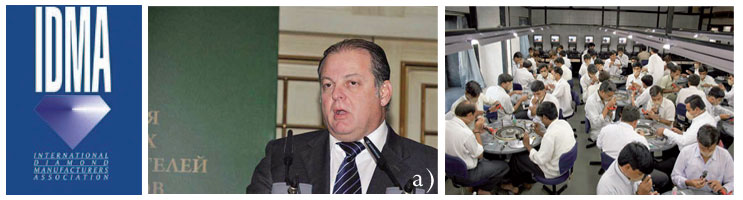
a) Mr Moti Ganz, Honorary President of the International Diamond
Manufacturers Association and Chairman of the Israel Diamond Institute |
|
| |
The Emergence of Speculation
The deep change in the diamond industry took
place as the year 2000 approached. We flowed with the
changes, increased efficiency, updated, cut back,
expanded, made connections downstream and upstream
on the pipeline, developed brands, set up jewellery
companies, joined jewellery partnerships, split, merged,
adapted our companies to best business practices in the
diamond industry, set up manufacturing plants in
countries with low labour costs at one end of the world
map and in countries that promised rough supply at the
other end. We worked hard, we sweated, we thought,
we were creative — all in order to adapt to the new order
in the world diamond industry, and boost it as much as
we could.
We did excellent work. It seems to me that despite
some slumps and difficulties, we felt great confidence
in our industry. We knew we were moving forward.
In 2007-2008 the financial bubble in the world
began growing. The diamond industry did not remain
untouched, and became inflated as well, on the level of
finances as well as stocks. The price rises were crazy,
speculations as a result of the currency policies in South
Africa and India caused a loss of any connection between the market price of rough and the price of
polished. There were sightholders who used credit they
received not to manufacture but instead to invest in real
estate or the stock market. In 2008, long before the
global credit crisis, I already came out in the trade press
and in international forums against irresponsible
increases in rough prices, which were driven by
speculation. I warned that the unreasonable euphoria in
the world diamond industry was leading to unreasonable
demand for rough at unreasonable prices. At the World
Diamond Congress held in 2010 in Moscow, I stressed
the extremely serious risk of the unrestrained increases
of rough prices, and the danger lurking.
However, as long as there was money around, the
wheels continued to turn and everyone enjoyed the
party. Only a few, including myself, shouted out —
Beware! In this game of musical chairs somebody will
fall behind. Perhaps more than one. Perhaps everyone. |
|
| |
An Abrupt Halt
At the end of 2008 the world encountered the
global economic crisis, the roots of which could be
traced back to 2000, with the burst of the hi-tech
bubble, which caused a preference for investing in the
real estate market, in turn producing a new bubble of
irresponsible use of inexpensive money by means of
unfounded loans, which allowed unrestrained purchases
of apartments and houses.
When the crisis broke out, everything stopped in
place — activity in the financial market and activity in
the diamond industry. The rough producers understood
that they were the only ones who could regulate the
market, and reacted quickly. They reduced production
and/or closed mines for a given period, and allowed
their customers to leave goods on the table. The Russians
activated their shock absorber — the Gochran (the state
treasury), which purchased Alrosa’s production. |
|
|
|
|
| |
The global economic crisis exposed some of the
fundamental weaknesses in the diamond business,
particularly the accumulation of inventory and
erroneous pricing. The suddenness of the global crisis
highlighted the vulnerability of the diamond industry to
external economic fluctuations.
Most of the banks in most of the centres acted with
the utmost responsibility, supported by diamantaires
who streamlined their activities and brought money
from home. However, some banks chose to support the
diamond centres by providing unreasonably generous
credit lines — again the speculations flourished, again
the prices of rough increased and again we found
ourselves in a whirlwind.
I repeatedly called upon the diamantaires: Don’t
buy rough at any price they ask. But rough continued
being sold, the prices continued to rise and there was a
festival of speculation. The rough producers — all the
producers — benefited from their ringing cash registers.
In order to maximize their profits even further, the
rough producers embraced the tender method, in an
effort to draw maximum benefit from the sale. The
difference between the price of rough and that of
polished dwindled to near nothing, as did the
manufacturers’ profits.
The manufacturers, who buy rough in order to
process it, are disappearing — cutting back
manufacturing, closing factories temporarily or shutting
them down all together. Even the well-established
manufacturers have to close excellent, well-organized
factories. Some are still holding on by the skin of their
teeth. But how long can a manufacturer continue to buy
rough if it means absorbing losses? A month? Two
months? Three? Half a year? The situation is worrying.
I apologize that I can’t avoid quoting myself, but
I articulated this in the past so well that there really is no
need to reformulate it. I wish I could say these words are
no longer relevant, but regrettably that is not the case.
In 2010, I wrote: “In the mining world, annual reports
and speeches stress the term ‘sustainable development.’
This refers to activities that have commercial viability
in the long term. Somehow, too many producers seem
to believe that when it comes to selling their product,
the short-term optimization of revenues is more
important than the long-term sustainable development
of their clients’ businesses. However, just as there are
fewer long-term commitments for supply to
manufacturers, these manufacturers should realize every
morning, over and over again, that every time we buy
rough at irresponsibly high prices we are damaging our
own long-term prospects. At the end of the day, those
who overpay will disappear, and the rough supplier will
simply find someone else who may await the same fate.
It is easy to dismiss this with ‘it’s a free market.’ That
isn’t totally true. We are not playing on an even, level
field. Rough speculators may lose or win some money.
Manufacturers, however, have huge investments in
factories and infrastructure and a workforce to protect.” |
|
| |
|
|
| |
Recently the rough producers realized that if they
didn’t lower their prices there wouldn’t be anyone to
buy their goods. Reducing prices is a double-edged
sword — it is essential because the manufacturers can’t
pay the prices demanded anymore, but it is a blow for those who bought goods at high prices, and benefits
those who had the wisdom to leave those goods on the
table.
It’s Not the Crisis
Our industry is stagnating. Not just in our country,
but all over the world. We tend to blame the economic
crisis. There’s a recession in the United States, the
European economy is collapsing, we say. But even in
times of recession young people continue to get married.
There are still occasions to celebrate. Moreover, the
economic situation in the US is not bad at all. At any
rate, it is not bad enough to cause a total halt — at the
most, a slight decline. The reason lies in the diamond
industry itself. As soon as it was no longer possible to
use bank credit for speculation, and a market emerged
of high rough prices that couldn’t be transformed into
money, the rough buyers began to “choke” and realize
their rough at 10 to 15 percent below the price demanded
by the major suppliers. The manufacturers who had
signed long-term contracts had to continue buying
rough at high prices, and meet the rest of their needs by
purchasing rough at impossible prices through tenders.
I would like to remind you what I said about
tenders at the International Rough Conference held in
Israel in 2008. Addressing the rough producers, I said:
“You will surely ask why the manufacturer’s troubles
should concern you? From our point of view, you’ll
say, the situation is ideal. We produce rough, sell it at
tenders, fetch prices we never could have dreamed of,
and our profits leave no room for complaint.
“A tender or an auction can be an excellent
solution as a ‘window’ onto the market, or the sale of
special diamonds. However, they cannot be a standard
solution, because they harm the manufacturer.
“The rough diamond has no value on its own. The
rough producer can’t do anything with these diamonds.
There were attempts to turn diamond into a commodity.
To try and make diamonds behave like gold, copper,
iron or coffee. That attempt failed. The rough diamond
is not worth money like metals are. Rough diamonds
can’t be used like coffee beans can. The rough diamond
is worth money only after it is polished. The rough
diamond is valuable only to — the diamond
manufacturer. Only I, the manufacturer, know what I
am holding in my hand and what can be done with
rough.
|
|
| |
|
|
| |
“So that I, the manufacturer, will want the rough
that you produce, I need to receive it consistently, on
the basis of ongoing, regular sortings. That’s the only
way I can make commitments to chains and to stores.
That’s the only way I can commit to ‘programmes.’
That’s the only way I can promise you that the rough
you produce will be worth something to the customer in
the store, and not only in the internal trade between us.”
When I finished speaking there was applause.
That was very nice, but in practice — nothing changed.
I barked and the profits of the rough producers continued
to rise, at the expense of the manufacturers.
We can’t continue buying rough at a loss forever.
It is impossible to continue manufacturing under the
present conditions. Without manufacturing, there’s
nothing to sell. If there’s nothing to sell — it won’t be
long (perhaps the day has already come) before the
display window will fill with more jewellery set with
precious stones, pearls and synthetic diamonds. And if
the public gets used to buying them — who will be able
to turn the clock back? A closed door of a factory is a
door that has no chance of opening. The storeowners
are tired of hearing us whine and ask for higher prices
while manufacturers of synthetic diamonds give them
goods on memo — and with a significantly higher profit margin. At first they’ll show the synthetics in a corner
of the store, but within a few years, they’ll display them
throughout the store. Look what happened with pearls.
This is already happening. Many diamond
manufacturers are now starting to manufacture synthetic.
Many others are considering adapting their production
lines to synthetic. The manufacturing system exists.
The marketing system exists. Why use it to create losses
when you can use it to make a profit? The infrastructure
is there, and if the rough producers don’t quickly catch
the manufacturers by the tail and keep them close to a
profitable supply — they will be able to regret what
happened, but not change it. Only recently a wellestablished
American diamond manufacturer told me
that if he hadn’t opened a line for synthetic parallel to
his regular system, he wouldn’t have survived, and that
he’s considering adapting his entire manufacturing and
marketing system to synthetics. Rough producers — is
that the road you are hoping we will take?
|
|
| |
Last Call
Therefore, while until recently I addressed mainly
the diamond manufacturers, asking them not to buy
rough at unreasonable prices, I now turn mainly to the
rough producers. Dear producers: Rough diamonds are
meant to be polished for setting in jewellery. They can’t
be eaten. They can’t be planted. They can’t even be
used for speculative purposes any more. You can
speculate for a year, or two years, but at the end of the
day, the mouth of that volcano opens up and destroys
everything around it. The rough producers need to
understand that a business in which speculation plays a
major role is not a business. It is a bubble that has burst,
and if it develops again — it will burst again.
Rough producers and manufacturers are in the
same boat — everyone wants steady business. Rough
producers want to know that someone will buy the
rough they produce. Rough producers have a duty to
the countries in which the mines are located. They have
a duty to the governments and to the people. They have
goals they must meet. If they don’t have anyone to sell
the rough to, they will have to get out of the mining
business.
Therefore, the producers must find a way to
support and encourage manufacturers. And here I
repeat the lessons of the 1970s and 1980s. The rough
producers must give the manufacturers very strong
backing, enabling them to return to the sphere of work
and establish themselves firmly in the market by assuring
steady clients who can rely on regular, certain supply.
The rough producers must also cultivate the dealers, so
that they can appropriately help those who manufacture
in small and medium volume and their employees,
either by financing or by supplying smaller parcels in
attractive sortings.
My advice to rough producers is this: The return
of speculation is not the end of the manufacturers alone,
but of the entire diamond industry. |
|
| |
|
|
| |
Men's Jewellery trends |
|
| |
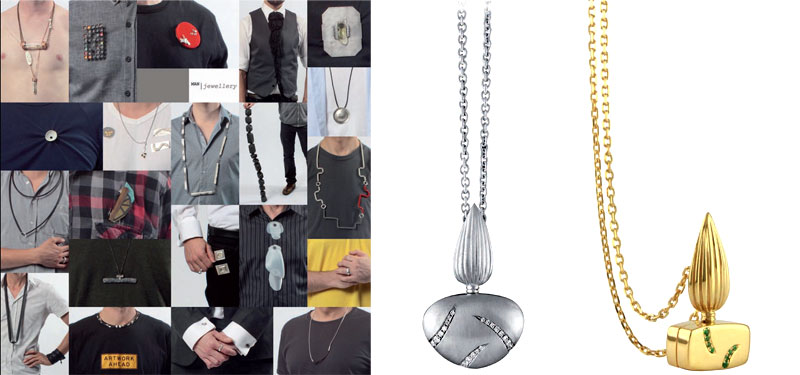
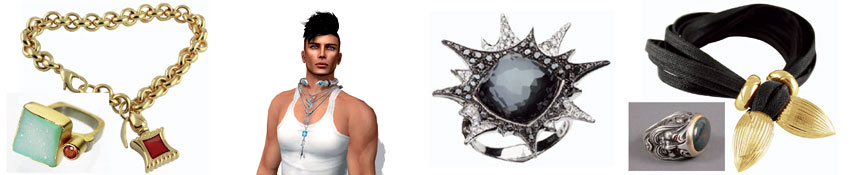
In the basement of the famous
Hix restaurant in London’s Soho in
July, British jewellery brand Stephen
Webster invited guests to an early
morning fashion show for the
unveiling of its new jewellery collection. But this breakfast event
was not the usual showcase of
jewellery because, as the guests ran
their fingers over the new collection,
their attention was halted as, strutting
across the bar, appeared Spandau
Ballet brothers Gary and Martin
Kemp and famous hairdresser Nicky
Clarke, adorned with the brand’s
new collection — a range of men’s
jewellery — kitted out with the
sharpest tailored suits and smart,
lace-up shoes.
But what did this parade of
men’s jewellery mean? It represents
a shift in the direction of the men’s
market, a more grown-up movement
that puts the surf beads to one side
as jewellery of smarter origins and
even bespoke designs take centre
stage.
Mark Ungar, director of
Thorn.co.uk, the leading UK
website dedicated to branded men’s
jewellery, says that recent market
developments show that men are
looking for a bit of refinement in
their jewellery. Gone is the Russell
Brand look of chunky finger rings
and layered chains and rosaries,
and in is a classic, gentlemanly style
with delicate details and considered
design.
“We find it used to be theleather, surf bead jewellery that men
went for but now they want
something different,” Ungar
explains. “For example skulls —
we’ve been there, done that. Men’s
choices have calmed down a bit;
it’s about being smart now.”
Steffans in Northampton
boasts a strong online presence in
the UK with its collections of
branded jewellery that includes
men’s ranges from Links of London,
Thomas Sabo, Shaun Leane and
emerging brands such as ChloBoy,
the range from up-and-coming
fashion brand ChloBo. Steffans
founder and director Steff Suter says
that the men’s market has shifted
and that the grip of gothic men’s
jewellery is weakening.
|
|
| |
|
|
| |
The emerging trend, it
appears, is a desire for something a
little more sophisticated, a shift that
reflects the changes that have taken emerging trend for heavy tweed
jackets, rolled up ankle-length
chinos, polished leather shoes and
smart bags. Overall, men are more
confident experimenting with their
fashion while opting for premium,
well-made goods.
This appears to have filtered
down into jewellery design and, as
Ungar explains, consumers are
following fashion’s move towards
something a little more gentlemanly.
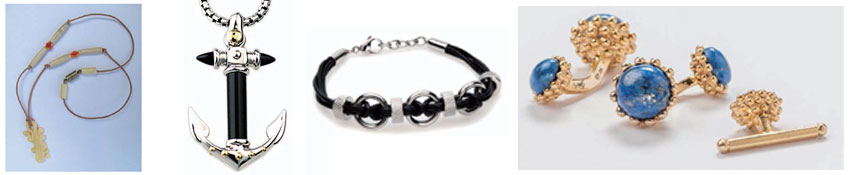
Single, understated rings, perhaps a
signet ring with a monogram or
cufflinks that do the talking are
becoming must-haves, even items
such as unusual tie pins are
becoming little objects of desire.
The signet ring is something
William Cheshire, founder of the
eponymous William Cheshire
brand, would love to see revived. “I
love a ring on the pinky finger, it
has a very ‘I’m in a private club
don’t you know’ look about it,” he
says. “[But] if there were any styles
I’d like to see the back of it would
have to be the Aussie leather
necklace, or a couple of beads,
Richard Hammond style – they’re
cool by the beach, but when the
City boys wear them it looks a bit
sad.” Essentially detail and interest appear to be taking hold in men’s
jewellery, a change that might be
the result of reining in design as the
industry and consumers continue to
work through the recession.
British jeweller Lewis
Williams, who works under the
brand name Lewis Henry Nicholas,
is a new designer on the scene and
though based in New York, says the
changes in demand for men’s
jewellery reflects a desire for quality
product with a story. He’s just been
snapped up by Kabiri, a fashionforward
independent jeweller in
London. “Recently men have
moved away from big hunks of
scary-looking jewellery and adopted
a more subtle approach,” he
explains. “I think men today are
genuinely interested in their
jewellery having a story and historic
references.” Williams adds that
taking design elements from
antiquity and interpreting them in
new ways is always going to be part
of men’s jewellery design. |
|
| |
|
|
| |
In Hatton Garden, fine
jeweller Nick Fitch, owner of
Nicholas James, has been making
bespoke jewellery for men for many
years. Last year he caused a stir
with a capsule high-end men’s
collection called Savage Solitaires
– solid gold rings with diamonds
and precious stones that referenced
the legend of Jack the Ripper.
Though Fitch’s work tends to be
mostly focused on fine men’s
jewellery such as wedding rings, he
too has noticed the move into
jewellery that represents a wider
shift in men’s fashion and shopping
habits. “The past two years leather
friendship bracelets became the
thing for guys, with little bits of
silver here and there – nothing
statement, quite casual,” explains
Fitch. “But suddenly I am seeing
guys, sharp dressed fellas in tailored
suits, and the last thing you expect
to see is a flash of gold bracelet
peeking out from under their cuff,
but that’s what they’re wearing
under their shirts.”
Stephen Webster meanwhile
says demand for his eponymous
men’s jewellery collection has
shifted. “In these difficult times
people tend to look for something a
little bit out of the ordinary and that
extra bit special – [the] reason why
our men’s jewellery sales are still strong,” he says.
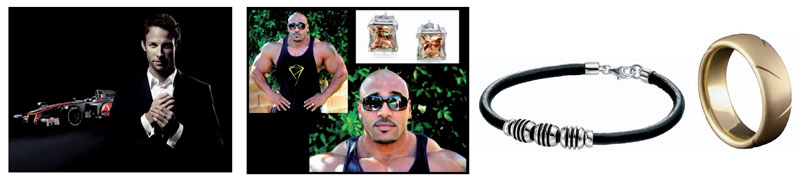
Earlier this year Links of
London unveiled a steel jewellery
collection, made with the license of
British Formula One race team
McLaren. It was designed by
Philippe Cogoli, a former Alfred
Dunhill employee who has been
head of design of watches and
men’s jewellery and accessories at
Links of London for four years. He
says the market has grown and
revealed two types of male shopper.
“Men’s jewellery is not so niche
[now], its market has increased quite
a lot the last few years, definitely for
Links, our men’s market is growing
dramatically,” he explains. “Now
you have two types as such, those
guys who want something very
trendy and the guys who want
something more understated, with
that bit of something extra. They’re
the ones who are ready to spend
more money so want a bit more
value in the piece, a different shape
or some versatility.”
But how have men’s jewellery
brands adapted their collections to
fit with this market and with it the
pockets of the current male
consumer? Conventionally the
majority of men’s jewellery has
never quite been able to command
high prices, aside from bigger name
brands, wedding jewellery or fine
jewellery with gemstones, due in
part to the accessory connotation of
men’s jewellery. Further many male
shoppers were – and still are –
dipping their toes into the more
upmarket jewellery realm.
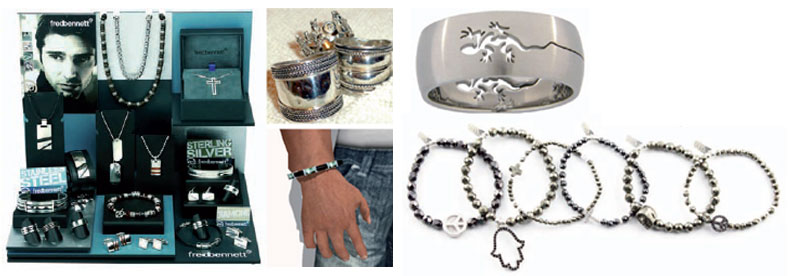
At Gecko Jewellery, where
men’s silver and steel collection
Fred Bennett is designed and
manufactured, price has always been
a key driver of each collection, to
maintain appeal for both retailers
taking on the products and the
eventual shopper. |
|
| |
|
|
| |
Hannah Trickett, head of
design at Fred Bennett, says the
gifting element to men’s jewellery
has meant designing with particular
price points in mind. “Price-wise,
steel jewellery has become a
bestseller over silver; because of its
ability to allow you to design
products that might become too
expensive if made in silver,” she
explains. “This has made steel very
appealing, but anything that goes
over the US$500 mark we struggle
to sell. That’s our top pricing limit.”
For Stephen Webster, a brand
known for its high-end jewellery
designs, the evolving price of the
raw materials has meant the brand
has had to adapt its collections;
something Webster says has been a
long-term, continuing challenge.
“We were never a brand who sold a lot of diamond men’s jewellery,”
he reveals. ”The price is always an
issue for wide appeal and also the
whole sparkly thing is too associated
with women’s jewellery and just
too pretentious for most guys.”
So does a more affordable
price go hand-in-hand with a simpler
design aesthetic? Possibly so, says
Ungar, who notes that the shift to
neat, more restricted styles of men’s
jewellery has come as consumers
tighten their belts. “Because of the
way the recession has affected
people I think the spend [on men’s
jewellery] is less compared to two
and half years ago,” he explains.
“When the going gets tough it’s the
classic with a little twist pieces that
sell.”
Cheshire agrees that male
customers often hunt around for a
good price, so he ensures that he
aligns his prices with those of his
retailers to retain fair competition.
“Mind you, it can be two years
before a customer comes back
[because] men tend to buy one thing
and really make it last,” he adds.
At Links of London the
McLaren range has been made
primarily in steel, with what it dubs
“masculine” materials such as
carbon fibre, Kevlar – the same
material used in bullet-proof jackets
– and black PVD used to give the
steel some personality.
Designer Cogoli says that
hitting key price points is always in
his conscious when designing, as
he has particular price targets to meet in his design briefs. “When
designing the current collection we
had several price points we had to
work to so I knew what I had to
achieve with the designs,” he
reveals. |
|
| |
|
|
| |
Nick Kovacs of IBB London,
owner and manufacturer of men’s
silver cufflinks and jewellery brand
Hoxton London, says that its
customer’s tastes have got a little
more adventurous but that
customers are still looking for classic
designs with small points of interest.
“Spinning rings, hinged bangles and
patterned cufflinks are becoming
bestsellers,” Kovacs explains.
“We’ve found the men’s market is
showing continual growth at a time
when very few product areas are
doing so.”
For Fitch, the majority of his
men’s jewellery sales will be of a
higher price due simply to the nature
of his work. However he
understands how the price of a piece
of jewellery really can make or break
a purchase. “Most men will spend
$50 or so on a friendship bracelet
[but] others will save thousands for
something special. Right now
they’re a minority, but a growing
one.” Fitch explains that men’s
jewellery is now beyond the fad
stage and that as the men’s watch and accessories market booms with
more men opting for higher-priced,
automatic watches or fine leather
goods, the men’s jewellery market
is beginning to follow.
While the high street has
enabled fashion retailers to
introduce men’s jewellery
collections, some designers have
found this has made attitudes
towards men’s jewellery difficult to
alter. Cheshire explains that it is
sometimes difficult to get male
customers through the door of a
jewellery shop purely because it is
retail space they will be largely
unfamiliar with. “[Male shoppers]
are more inclined to see jewellery in
fashion stores, such as All Saints or
Topman for example,” says
Cheshire. “This is usually quick
fashion items aimed at the youngermarket [but] the independents are
getting in on the game, allowing
more space in the stores and using
the web to portray a more masculine
image.”
The online arena appears to be the most important platform for
driving men’s jewellery sales,
however, as it allows them to sit
back and browse products, compare
prices and make purchases without
having to enter a store — perhaps
an ideal, comfortable middle ground
for shoppers who might not yet be
prepared to step over the threshold
of a store to try on a necklace or
ring. |
|
| |
 |
|
| |
Ungar’s customer base
certainly supports this view. He has
found that his international
customers appear a lot more comfortable shopping online, and
while UK sales are steady most UK
shoppers will make entry-level trial
purchases before shopping for more
expensive goods. “We sell a lot
online to America and Australia
and have had a number of shoppers from Russia,” he explains. “The
Americans are more than happy to
shop online and so they will spend
more, while the UK’s men’s market
is more about trying out shopping
online with a small purchase of
around $250.”
Cheshire concurs: “I found
the majority of my website orders
are from men, so I’m inclined to
suggest chaps prefer to shop around
online rather than go for the impulse
buy from a shop.”
At Thorn, marketing has been
key and the use of search engine
optimisation, Google Ad Words and
pay per click initiatives ensures that
the company remains top of search
results through Google. “We make the most use of key words that are very simple search terms, plus particular designer names that we know will be popular searches as well," explains Ungar.
Even online retail giants such as Asos are host to men's jewellery, not only own-branded products but also fashion-led collections from Simon Carter, Vivienne Westwood and Armani. Of note, however, is the lack of men's precious or silver jewellery, perhaps due to its target market. Conversely, high-end men's fashion site Mr. Porter, brother site to luxury women's retailer Net-a-Porter, does boast a capsule collection of men's jewellery including 18K gold and bllodstone signet rings.
|
|
| |
 |
|
| |
As with any industry as time evolves new faces come through and, along with Lewis William's collection of jewellery, several other designers have been tipped for the top by the industry. Both Stephen Webster and William Cheshire namecheck Tomasz Donocik as their rising star of men's jewellery and thought he is not the newest player on the scene, his designs have certainly caused a stir, with Webster describing him as "a very dynamic guy" and Cheshire admiring his "good feel for men's jewellery, style and wearability"
Thorn's Mark Ungar meanwhile is supporting emerging designer Lukasz Pasikowski, founder of Cardinal of London. Ungar spotted his work at Treasure at Jewellery Week in June and commends him for offering something a little different with his selection of hand-crafted animal head men's jewellery and bangles and rings that appear hewn from rocks.
Nick Fitch has also reacted to the changing market and, designed to launch simultaneously with a new Nicholas James website his month, he will reveal a new carefully priced men's jewellery collection designed in partnership with his long-term collaborative partner Harcourt, a leather specialist. The new range will be priced upwards of $325 and will include items that can be traditionally monogrammed or set with birthstones.
Certainly it appears that the men's jewellery market has moved on, or at least in a newdirection as men begin to appreciate design and want more from their jewels. While there are still plenty of entry-level options such as the ranges from Fred Bennett and Hoxton London, the rise in men looking fo items unique to them that have a classic, gentlemanly aesthetic shows a return to safe, quality goods that will might command a premium price but will ultimately last.
|
|
| |
|
|
| |
The Transition from Diamond Dealers to Jewellery Manufacturers
By: Iris Hortman, Israel Diamond Institute Information Officer
|
|
| |
Over the years, the Israeli
Diamond Industry has focused on
selling an assortment of diamonds
— both rough and polished
diamonds. In the opinion of most
diamond dealers, the design,
production, import and export of
jewellery were not considered to be
an effective way of promoting or
marketing the diamonds in their
possession. But times have changed:
the Israeli diamond industry has
undergone changes and the
worldwide jewellery industry has
experienced globalization. The
attitude that a piece of jewellery can
promote diamond sales has been
changing in recent years.
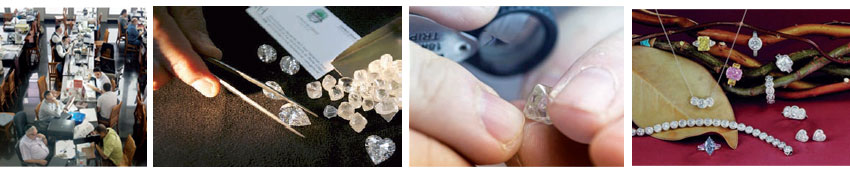
The marketing of diamonds
embedded in jewellery produces an
added benefit for the exporter,
because the sale of a piece of
jewellery embedded with diamonds
maximizes the profit from the
diamonds, which can reach 20%. In
addition, embedding diamonds in
jewellery allows for the use of
diamonds of lesser clarity, which
constitute the bulk of the diamond market. Embedding a diamond in a
piece of jewellery can, if done
correctly, hide the diamond’s
imperfections with its metallic
components.
Today it is much easier for
diamond dealers, even those
working at a smaller scale, to market
diamonds embedded in pieces of
jewellery. It is easy to acquire pieces
of gold jewellery ready for
embedding, and embed within them
any diamond, and then to sell it
already embedded within the piece
of jewellery. A diamond dealer is
not required to maintain a collection
or inventory of pieces of jewellery
-- he or she can respond individually
and immediately to the customer’s
preferences regarding a piece of
jewellery, by acquiring a piece of
jewellery ready for embedding. |
|
| |
 |
|
| |
In spite of that, if diamond
dealers insist on developing unique
models, they can be ordered from
specialty stores, or one can learn
how make them oneself, with the
aid of computer programmes
available on the market. The
jewellery production process has
been greatly simplified these days,
using computerized design
programmes, which allow one to
examine the piece of jewellery from
every possible angle, to calculate in
advance the amount of material
needed, and even its sale price. The
computer sends a file with all the
required information to a special
printer which smelts the models
directly into moulds ready for the
next stage of the production process
— the creation of rubber moulds,
and the production itself.
In recent years, a labour force
highly skilled in all tasks related to
jewellery production has joined the
Israeli industry: the wave of
immigration to Israel from the
former Soviet Union. These
migrants brought with them
reservoirs of knowledge, skills and
abilities that advanced the jewellery production and embedding
industry.
With all of these advantages,
why wouldn’t diamond dealers use
the embedding of diamonds in
pieces of jewellery as a way to
leverage their marketing of
diamonds?
Some diamond dealers
believe that the changes in
accounting and processing that
would be required in the transition
from the export of diamonds to the
export of jewellery will pose
challenges. |
|
| |
The export of jewellery does
not require one to pay Value Added
Tax, but it requires that it be
reported, something that is not the
case with the export of diamonds.
Diamond dealers are hesitant to
adopt this step because it would
require changes in their accounting
systems, the establishment of an
additional company or legal body
and extra expenses. Though it
should be recalled that VAT may
add to the workload, and also
perhaps be an additional expense
to the diamond dealer, it does not
require a capital expenditure. As
well, diamond dealers who open a
VAT account can receive VAT
refunds on moneys spent on
materials and labour to create and
embed the jewels.
Another process that
exporters must adjust to in the realm of jewellery essentially results
from the need to record the export,
like all products exported from
Israel. The record is carried out by
a customs official via an agent,
which necessitates a fee, as opposed
to the way it is done currently, at the
customs desk in the Israeli Diamond
Exchange. |
|
|
The jewellery delivery
process, as opposed to diamond
exports which are carried out
directly from the exchange itself,
are carried out via delivery
companies, using couriers or secure
couriers. This process can
sometimes involve an extra fee in
addition to the cost of delivery,
such as a charge for storing the
merchandise in a safe. This storage
fee can sometimes be quite high in
the event that the delivery does not
take place over business days, but
on weekends or holidays. This
problem can be overcome by
advance planning of the export
process.
Certainly, there are ways to
reduce the expenses associated with
jewellery exports. In conversations
I have had with diamond dealers
and jewellery manufacturers for the
purposes of this article, several
methods of making the export
process easier were suggested. For
example: opening an additional
customs office at the diamond
exchange for the benefit of diamond
dealers who require jewellery export
services, in order to make it easier
to possess pieces of jewellery for
the purpose of repairing them, and
other similar uses.
The export of jewellery
produced in Israel entails the
advantage of the priority status they
are granted by customs. Israeli-made
jewellery falls under the free-trade
agreements which Israel has with
other countries, such as the United
States and Europe, and is therefore
exempt from customs fees. This
advantage will only increase as
Israel’s trade agreements are
expanded upon, especially with the
countries of East Asia.
The sale of jewellery
embedded with diamonds advances
the diamond trade. In this way,
diamond dealers can work directly
with the final customer, the jewellers,
in order to save themselves
middleman fees and thus maximize
their profits.
|
|
|
| |
|
|
|