| |
| Pakistan
Gem Industry Slows |
Pakistan's
gern and jewellery exports have boomed in recent years
but rniliiant violence, a crippling power crisis and
outdated proauciion methods are taking their toll
in Peshawar, vi/here tradlers say business has slumped
alarmingly in the past 12 rnonths.
Traders like Shenzad
Sabz Ali say business is collapsing, and foreign buyers
in parlicular have been scared off — a major
problem in a sector where exports account for 95 percent
of the market "I have been in this business for
the last 25 years but that we are witnessing these
days of unrest and Talibanisation is uprecedented,"
he said.
The buyers from the
United States, Thailand, France, Germany and Dubai
who once thronged the packed market are largely a
thing of the past. "The bomb blasts and suicide
attacks have turned our businesses upside down, leaving
us no option but to interact Online dealing may be
the thing of the built on generations of salesmanship
and relationships, feel it is ineffective. For fellow
trader Sheharyar Ahmad, the and Lahore where foreign
buyers ruby and sapphire."
Most of Pakistan's gemstones
are found in Khyber Pakhtunkhwa, northern Gilgit-Baltistan,
Federally Administered Tribal Areas, Pakistan administered
Kashmir region and Baluchistan. The reserves of precious
and semi-precious stones in Pakistan are vast, according
to Peshawar-based gemmologist llyas Ali Shah. But
much of this potential remains uptapped as the stones
lie buried in the seven restive fribal areas along
the Afghan border, where militancy and poor infrastructure
have restricted access, "Pakistan could triple
its gemstone exports if these reserves are fully tapped,
"he said. |
|
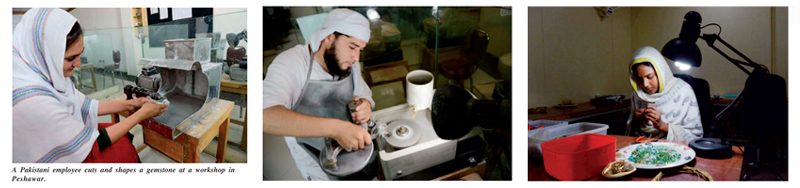
While the quality of
stones from Pakistan is good and they sell well at
international trade shows, Peshawar trader Sheharyar
Ahmad said, the local cutting and polishing techniques
are not up to international standards. “That
is why when our stones go to Thailand, they are re-faceted
and polished again."
Shah, who heads the
Gem and Jewellery Training and Manufacturing Centre
in Peshawar, said the manual equipment Pakistani traders
are still using did not allow the same precision and
delicacy of workmanship as modern machinery. His training
centre aims to bring Pakistani jewellery techniques
up to date. “Our institute has been set up to
train traders in cutting and polishing of gemstones
through scientific means and we have so far trained
over 1,000 students in Peshawar," he said.
The government-run Pakistan
Gems and Jewellery Development Company (PGJDC) is
also trying to raise skill levels to allow the country
to compete better with the likes of Thailand and lndia.
Gem and jewellery exports
have risen enormously in recent years to stand at
$1.3 billion in 2013, and PGJDC general manager Khalid
Aziz said they were aiming for a target of $1.7 billion
by 2017.
|
| |
|
| Clarity
Enhancement for Tourmalines |
| |
|
Arthur Groom and Fernando Garzon of larity Enhancement
Laboratory (CEL) in New York developed a new process
whereby fissures in tourmalines can be enhanced
for better face-up appearance, CEL's "Excel"
product for emeralds already has been proven to
be stable, so the filler doesn't leak and change
colour, is properly disclosed and brings out the
natural beauty of the stones.
Using the same science from Excel, Groom and Garzon
developed a new ExCel, Groom and Garzon development
a new ExCel enhancement for tourmalines to reduce
the visibility of fissures and other open inclusions.
ExCel for tourmalines (used on the stone pictured
at the top) is already being applied to thousands
of carats of tourmalines. |
|
"What most
do not realize, is just how much tourmaline
has already been enhanced - not just by us,
but by others in the trade. Yes, our new tourmaline
enhancement does mask the fissures in tourmalines
very well," Groom said.
"But what we are really selling here is
the stability factor. All of the other enhancements
out there are unstable. Those enhancements all
leak out and they all discolour. I'm surprised
that no one has really complained about it.
I guess they feel that this is traditional too,
" Groom said. "We enhance only finished
polished goods. We enhance it once, and it's
done forever, It's stable."
|
|
|
| New
York Tightens Ivory Ban |
| |
|
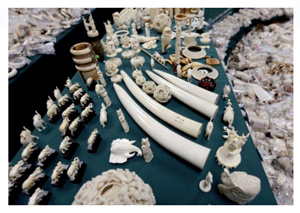
New York's Governor Andrew Cuomo signed
legislation that amends the state's environmental
law to ban elephant ivory, mammoth ivory
and rhino horn sales in New York, This state
legislation enhances federal efforts to
tighten the ivory trade ban on a federal
level. Under the law, this permanent ban
on the sales of these products has only
a few small exceptions, The legislation
authorized New York's Department of Environmental
Conservation to issue permits for the sale
of the following items made from these products:
- 100 year-old antiques comprised of less
than 20 percent elephant Ivory with documented
proof of prevenance:
- Musical instruments(string, wind and piano)
manufactured prior to 1975:
- Elephant ivory where trasfer of ownership
is for education and scientific purposes
including to a museum authorized by special
charter from these products:
|
|
- 100 year-old antiques
comprised of less than 20 percent elephant
ivory with documented proof of provenance:
- Musical instruments (string, wind and
piano) manufactured prior to 1975:
- Elephant Ivory where transfer of ownership
is for education and sctientific purposes
including to a museum authorized by special
charter from the legislature;
- Elephant ivory where transfer is to
a legal beneficiary of a truth or estate.
All other sales
of these products are now banned in New
York. The law also increases penat lties
for violation . Inclusion : a fine of
$3,000 or 2x the value of the article,
whichever is greater, for the first offense,
and a fine of $6,000 or 3x the value of
the article, whichever is greater for
the second offense. Selling articles with
a value exceeding $25,000 is now a class
D Felony, with a penalty of up to seven
years imprisonment.
This law takes
effect immediately. Existing licence and
premit holders may sell Ivory and photo
hom as defined on their licenses and permits
until the current licenses or permits
expire. The New York State Development
of Environmental Consevation is directed
to provide additional information on following
this new ban within 30 days. New York
now joins New Jersey, where the New Jersey
state legislative this year approved a
bill prohibiting most sales of Ivory (elephant,
hippopotamus, mammoth, narwhal, walrus,
or whale) and rhino horn.
|
|
|
| Moissanite
- Covered CZ Discovered |
|
Cubic zirconia covered with a film of
moissanite has been discovered in India,
and it's possible detectors would flag
it as pure moissannite, Charles &
Colvard CEO Randy McCoullough announced.
McCullough says that a distributor discoverred
several pieces of moissanite-covered cublic
zirconia on the market in india. McCullough
believes the items would test positive
the for moissanite, which generall retails
above cubic zirconia. None has been found
in the United States.
"it's not
a widespread thing to my knowledge,"
he says, "But all goes back to, if
it sounds too good to be true, it probably
is. Be careful if someone is trying to
sell you something that is 30,40 percent
under market." He says the company
has been a lot of generic moissanite in
India and China, since the company doesn't
have a patent there.
Charles &
Colvard also announced mixed financial
results for the second quarter of 2014
(ended June 30), Sales rose 20 percent
to $7.8 million, with U.S. sales increasing
35 percent, to $7.3 million. International
sales fell 50 percent, to $600,000. The
company posted a $6.2 million net loss
for the quarter, compared to a $500,000
gain the prior year. The net loss for
the quarter was fueled by an income tax
expense of $4.2 million, it also secured
a new three-year, $10 million asset backed
credit facility from Wells Fargo Bank. |
|
|
|
|
| Sarin
Invents New Diamond Instrument |
| |
|
A leading
diamond technology developer invented a new instrument
that can grade a stone's symmetry. Singapore-traded
and Israeli-owned Sarine Technologies announced
that upon the request of Tiffny & Co. It has
come up with a new machine called the Diamension
Axiom which ascertains a round or fancy -shaped
polished diamond's proportions.
The seed for the Axiom was planted three years
ago, when Tiffany challenger Sarine to develop
a tool which could measure facet symmetry to a
new set of standards established by tiffany. At
that time, there was no technology capable of
automating these measurement; they had to be conducted
manually by gemmologists using microscopes.
Axiom's abilities even extend
to measuring a gem's minute features, such as
facet junctions, facet misalignment and facet
distortions - all neccessary to accurately grade
a stone 's symmetry. Tiffany senior vice-president
Andy Hart praised the Axiom saying it would enhance
the work of the film and allow it to continue
providing its customers with the highest-quality
diamonds. |
|
|
|
Diamonds
from CAR Fuelling Conflict |
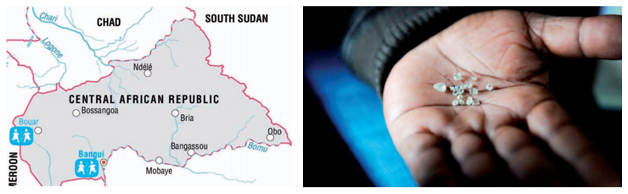
Diamond and gold are helping to fuel the Central African
Republic's (CAR) religious violence accordin g to
news reports.
The Ndassima goldmine, which is owned
by the Canadian mining company Axmin and which was
overrun by the mainly Seleka rebels more than year
ago, forms "forms part of an illicit economy
driving sectarian conflict, " the report says.
Axim suspended activity at the mine in late 2012 after
it was occupied by the rebels.
Despite a ceasefire being signed last
month many fear that the warlords on both side will
resist resources, especially the gold and diamond
mines. |
|
"Commanders on both sides are profiteering from
this conflict. Both the anti-balaka millitia and Seleka
are involved in gold and diamonds," Kasper Agger,
field researcher for the Enough Project, a to make
peace , we need to offer them an economic alternative."
Last year, the Kimberley Process
imposed an export ban on the CAR. The transitional
government of President Catherine Samba Panza is trying
to enforce a "traceability" scheme to prove
that diamonds are not mined in rebal territory. Despite
the ban, diamonds from the CAR are still being traded,
"(D)iamond fields around Bria and Sam Ouandja
provide revenue for rebels, who extract protection
money and sell diamond to dealers in Sudan and Chad,
expects say. From there, the gems are trafficked to
Antwerp, Dubai or India."
The industry has been warned against buying
goods from CAR. "Illicit trading in diamonds
from the CAR not only undermines the efforts of the
international community to restore peace in the country,
but it challenges the repulation of the Kiberley Process
Certification Sceme and the efforts of our industry,
government and civil society to eliminate the trade
in confict president , Edward Asscher, said.
|
|
| US
Probes Zimbabwe Deal |
The United States has placed a German bank under
surveilance for clearing payments for the sale
of diamonds from Zimbabwe at a Dubai diamond tender
in the second half of July. Commerzbank AG of
Germany was responsible for cleaning payments
for the diamonds, but has been targeted by American
officials for allegedly violating the US international
Emergency Economic Powers Act and the Trading
with the Enemy Act, according to state-run newspaper
The Sunday Mall.
It said
the United States was also investtigating six
banks in Germany, France, Italy and Japan - through
the Office of Foreign Assets Control - for processing
transactions involving countries under merican
sanctions.
|
|
|
The paper said the Zimbabwean government
was taking measures to counter the sactions by slashing
diamond exports in a bid to add value by having the
stones polished locally, and in the process creating
at least 1,000 jobs, "A processing centre will
be set up on Harare's outskirts, and the initiative
- which received cabinet approval last month - will
see government earn returns of up to five times what
it has got from selling rough diamonds, "the
paper said.
Seven Zimbabwean diamond
mining firms last month sent parcels totaling 960,000
carats to the two-week Dubai Daimond Exchange auction
in the United Arab Emirates where they hopes to earn
over $100 million. |
|
| Less
Jade at Myanmar Sale |
The Myanmar goverment expects to earn 2 billion
euros in jade sales at the major gems emporium in Naypyidaw
last month, although a smaller supply of jade stone
was available compared with previous years, an official
from the Ministry of Mines says.
At the 2014 Gems Emporium, buyers perused 7,160
jade lots, owned by the government and private miners,
compared with 10,000 jade lots last year and 15,000
in 2012. They can also about 400 lots of other gemstones
and 200 pearl lots. More than 4,000 traders from China,
Hong Kong, Thailand and Japan attended the emporium..
"The jade lot
sales rate last year were at 2 biliion euros, so we
expect to reach the same amount this year, though we
have fewer lots this time, "said Min Thu, assistant
director of the ministry's Myanmar Gems Enterprise. |
 |
He said the goverment wanted to reduce sales
of raw jade to promote value-added products, which
would be more profitable. "The goverment told
traders to Myanmar goverment expects to earn 2 billion
euros in jade sales at the major gems emporium in
Naypyidaw last month, although a smaller supply of
jade stone was available compared with previous years,
an official from the Ministry of Mines says.
At the 2014 Gems Emporium,
buyers perused 7,160 jade lots, owned by the government
and private miners, compared with 10,000 jade lots
last year and 15,000 in 2012. They can also about
400 lots of other gemstones and 200 pearl lots. More
than 4,000 traders from China, Hong Kong, Thailand
and Japan attended the emporium..
"The jade lot sales
rate last year were at 2 biliion euros, so we expect
to reach the same amount this year, though we have
fewet lots this time," said Min Thu, assistant
director of the ministry's Myanmar Gems Enterprise.
He said the government wanted
to reduce sales of raw jade to promote value-added
products, which would be more profitable. "The
goverment told traders to reduce raw jade sales and
to improve technology for value-added gems and jade.
Now the Gems Entrepreneurs Association is working
with Chinese technicians to raise the value of jade
and gems, to have a better price in the future." |
Win Maung, a gems merchant from Mandalay,
said in the past raw jade was sold to Chinese traders
who processed the stones in China. "Chinese are
better at adding value to the jade materials,"
he said, noting that Burma lacked the sophisticated
technology required to process gemstones. The Burmese
government last year said it planned to establish
a jade and gemstone centre in Naypyidaw, where it
hoped traders and investors would open stores and
processing industries.
Burma produces the majority
of the world's jade. Most is sourced from Hpakant,
350 km north of Mandalay, in the conflict -torn mountains
of Kachin State. Trade in jade is controversial. Competing
claims over the jade mines have helped fuel a war
between the government's army and the Kachin independence
Army (KIA). Historically, gem sales have been a major
source of revenue for Burma's rulling elite as well
as the Kachin rebels. The government and the KIA controlled
the jade mining industry in Hpakant between a ceasefire
deal in 1994 and 2011. After fighting resume in 2011,
the overment suspended large-scale mining operations
in the area. Small-scale miners and hand-pickers moved
in illegally to try their luck.
At the emporium, many
merchants who are no longer exploring jade in northern
Burma are showing off old jade lots that have remained
in their possession. "I still can''t say when
the government will allow them back to explore jade
in Burma. I heard a better gems policy needs to be
approved-explorers and merchants are waiting for this
law to be approved, " Min Thu said.
In February this year,
during a meeting with President Thein Sein, Burmese
tycoon Tay Za called for a better gems policy. Tay
Za, who chairs the Myanmar Gems and Jewelry Entrepreneurs
Association, urged the government to investigate the
mining situation in Kachin state, where he has extensive
business interests, He told the president that Burmese
citizens of Chinese ancestry were heavity involved
in the mining industry and were exporting gems over
the border to China. As a result, he said, value-added
industries had developed in China but not in Burma.
|
The former military government started selling
gems and jades at three emporiums per year in the
early 1990s. The Ministry of Mines says more than
526 million euros worth of jade and gems were sold
at 49th Gems Expo in 2012, compared with more than
2 billion euros in 2013. Gem sales have slowed, however,
after the Chinese government doubled import taxes
on Burmese jade. The raw stones are often smuggled
over the border to China through unregulated trade,
without ever being taxed. |
|
| GIT
World's Jewelry Design Awards 2014 with THeme 'Battle
of Colors: THe DEsign Your Eyes Can't Ignore' |
|
The Gem and
Jewelry Institute of Thailand (Public Organization)
or GIT has organized the judging for the 8th Edition
of GIT World's Jewelry Design Awards 2014 with the
theme of "Battle of COlors:The Design Your Eyes
Can't Ignore" The judges have selected the 6
finalist designs, and these are being made up as actual
pieces of jewellery , to be displayed by leading models
at the final judging of the winners. This will take
place on 26th November 2014 in the Eden Zone of the
Central World Shopping Centre, Bangkok.
Ms. Pornsawat Wathanakul,
Director, GIT, says that in arranging this 8th edition
of the GIT World's Jewelry Design Awards 2014, the
Institute has for the first time ornanized the contest
as an event at world level. This stems from the film
belief that creating value-added in products through
design must be regarded as the key to success in the
key to success in the gems and jewellery business.
At present, the industry is still short of highly
skilled Thai jewellery designers. At the same time,
the new generation designers do not have adequate
forums where they can display the power of their creativity
and unbounded imagination.
This year, GIT has elevated
the Awards contest to the world class level. There
have been international submissions from all countries
such as Thailand, USA, Italy, England, Dubai, Iran,
India, Japan, Taiwan, Singapore, Malaysia, Indonesia,
and Vietnam. Altogether 303 entries were submitted,
there being 85 designs of gentlemen's jeweller, and
218 designs of ladies' jewellery.
|
|
In the first around of judging, Ms. Pronsawat
explains that entries were separated into the two
categories: gentlemen's jewellery, and ladies' jewellery,
The designs were judged for beauty, distinction, creativity,
and their harmony with the theme of the contest: Battle
of Colors : The Design Your Eyes Can't Ignore,"
There were 7 highly qualified experts making up the
judging panel.
Initially, 36 designs
were judged again and point scores, thus becoming
the finalists: 3 designs of gentlemen's jewellery
and 3 designs of ladies' jewellery. These 6 finalist
designs are being made up as real jewellery. This
manufacturing project Factory by Beauty Gems Factory
Co., Ltd. Concept Manufacturing Co., Ltd. Cifac Co.,
Ltd., Marvel Jewelry Co., Ltd. and Pranda Jewelry
Public extended by Benson Jewelry Co., Ltd. Lee Seng
Jewelry, Pandora Production Co., Ltd. and Primier
Gems Trading Co., Ltd. |
|
The 6 finalist
jewellery pieces will be worn by leading male and
female Thai superstars, competing for top position
in the final around of judging on Wednesday 26th
November 2014. In the Eden Zone, 1st Floor, Central
World Shopping Plaza, Bangkok.
At the same location
there will be on exhibition of the designer's drawings
of the 30 semifinalists and design drawings by GIT
students, together with jewellery products. This
exhibition will held 25-26th November 2014, during
10.00-19.00 hours.
GIT invites
interested people join the vote for Popular Design
Award 2014 on GIT website http://www.git.or.th within
21st Movember 2014, and those voting will be eligible
for a prize.
|
|
 ,
a New synthetic Material from Russia ,
a New synthetic Material from Russia |
For 15 years Rusgems Company has been known
in the jewellery market as a manufacturer of synthetic
raw materials. We can say without exaggeration that
with regard to the range of offed goods. Rusgems are
unrivalled. Products we offer include such popular
materials as cublic zirconia, corundum and quartz,
as well as exotic crystal such as TIO2, Muassonite,
YAG, etc.
The demand for Rusgems' materials
keeps steadlily growing, which is clearly evident
now, during the world economic crisis. It is not surprising
that a customer has become for more careful in his/her
choice of high-priced jewellery and is putting economy
in first place. All jewellery producers have to face
the same problems. On the one hand the prices of natural
gemstones both precious and semiprecious are steadily
rising due to inflation and production cutbacks. On
the other hand a customer isn't willing to spend as
much as he could afford to before the crisis, in such
a manner customers are, so to speak, pushing companies
to cut prices. This situation inevitable forces the
producer to seek synthetic counterparts. Let's see
what one can find on the market nowadays: |
|
-Glass, Variety of colours
and moderate price could be counted as advantages.
Disadvantages are not so few; poor hardness, bad optical
indexes, existence of internal bubbles, impossible
to use the"moulding with stones" technique.
Therefore in no way glass could be considered as a
good imitation of natural stones.
-CZ this is the most
popular material since it has high optical rates,
good hardness, and wide colour scale. It is also relatively
cheap. But over the years CZ became "boring"
to the customers and more and more people tend to
consider it to be "bad form" for its unnatural
gloss (as Europeans say, it"impudently shines").
As such, CZ is regarded to be similar to the group
of goods which includes glass costume jewellery (intended
only for single use)
-Corundum, Colour range is limited
to 6-8 tints. It is generally popular as imitation
of ruby and blue sapphire . All options with the exception
of ruby are rather expensive. Corundum has very high
hardness. Therefore, there are difficulties woth its
processing. The crystals are limited in size (the
thickness of blue colour crystals doesn't exceed 9
mm) and often have non uniform colouring. As a result,
the manufacturer faces the problem of high quality
faceting.
-Spinel. All aspects
relating to corundum refer to this material as well.
Blue crystals are generally used.
-Quartz. The colour
scale includes 6 tints. Quartz is significant as a
material that is used for imitation of natural amethyst,
citrine, smoky and green quartz, Synthetic raw material
that is used for imitation of natural amethyst, citrine,
smoky and green quartz. Synthetic raw material itself
is rather material itself is rather xheap. However,
there are some difficulties when it comes to polishing,
which affects the cost of the facetted stones. B esides,
these cystals cannot be heated. Thus, the manufacturer
of jewellery can only use manual clip of stones, which
obviously increses the price of the product. |
 |
-Hydrothermal Emerald, Czochraski Alexandrite,
Muassonite etc. This group includes expensive synthetic
crystals that could serve as a perfect imitation of
natural stones. The high price , however, keeps them
from being widely used.
The review above reveals that, despite the
wide range of options, there is still a need for a more
optimized raw material.
Let's define the requirements of synthetic
raw materials, taking into consideration what was said
at the begining of this article:
-Reproduction of the exact colour of the natural
counterpart
-Wide
range of colours
-Optical
characteristics (gloss) close to those of the natural
counterpart.
-Optimal
hardness (7 on Mohs scale0., l.e. neither too soft nor
too hard.
-Capability
to be heated over 500 degress Celsius (i.e. wax casting)
- Consistent colouring
within a piece and from one lot to another.
- Opportunity to makes
stones of middle and big sizes
- Optimal density
- Affordable price |
 |
Till recently there
was no material that completely matched all specified
criteria. Today we are glad to introduce NANOSITAL.
We developed it at Rusgems as a product that entirely
fulfills existing demands.
NANOSITAL is an optically
transparent polycrystal material that is produced
by crystallization of glass that has certain chemical
composition. Compared to glass, NANOSITAL has higher
physicochemical characteristics. NANOSITAL falls under
the group of glass ceramic materials which have been
known for over 50 years and have wide rangers of compositions
and applications.
Rusgems adapted existing
technology to the needs of jewellery producers and
managed to create the optimal gem material. The multi-component
high temperature composition is based on two oxides
SIO2 and Al203. It's well known that these oxides
are the main components of most of the natural gemstones.
The other NANOSITAL
components are selected in order to meet requirement
concerning optical characteristics, density and hardness.
Our technology allows modifying components of composition
in various ways to achieve perfect correspodence between
NANOSITAL and its natural counterpart.
It is common knowledge that
the idea of "beauty" is essential for the
jewellery business. It's a more or less a subjective
criterion which in our case embraces both colour and
gloss.
At Rusgems we cherish
the desire to produce material which would fascinate
every customer. This goal was reached by inventing
NANOSITAL. The new materials completely different
from anything else that could be found on the market.
Any comparison would prove it to be best of its kind.
To gain such high performance
we not only use Rusgems' own state-of-the-art techonological
equipment but also latest research and development
achievements but also latest research and development
achievements in the field of material production.
|
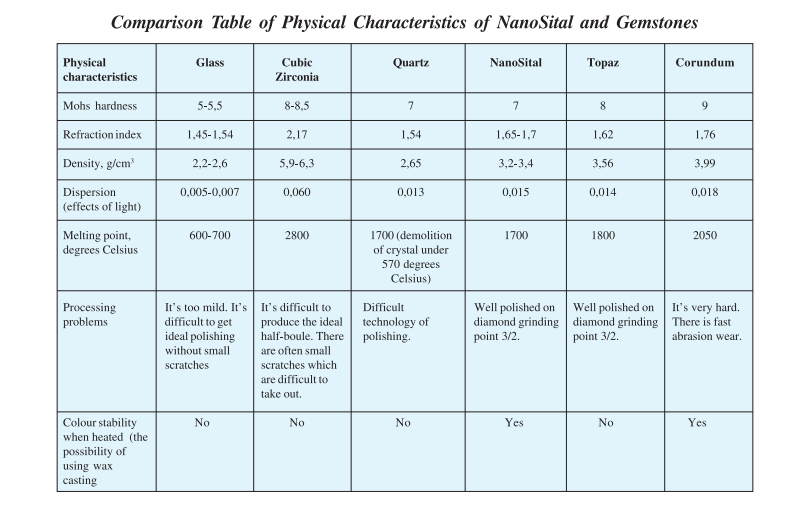 |
NANOSITAL is synthesized
at a temperature of 1700 degress Celsus. Its main
chararcteristics in comparision wuth well-known materials
are shown in the table. It is evident that NANOSITAL
is quite similar to topaz in many ways. NANOSITAL's
transparency and wide range or colours allows it to
initate alomost all types of coloured natural stones
from topaz and garnet to emerald and sapphire.
We should mention that
there have already been some efforts to produce the
material which is similar to NANOSITAL on the
market. The producers of glass-ceramics, for instance,
announce that they can provide a variety of coloured
imitations. Nevertheless, it turns out that there
are only a few options. And though the name Sapphire
or London Blue is used, it means nothing else than
blue colour. Still, as started above, the exact reproduction
of the colours is what matters to a customer, which
means that the stone should not be merely blue, but
has to be sapphire blue or the shade of London Blue
Topaz.
As for NANOSITAL,
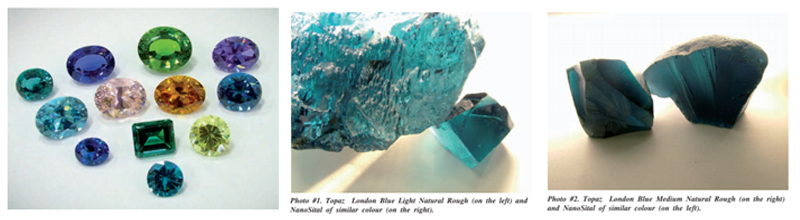
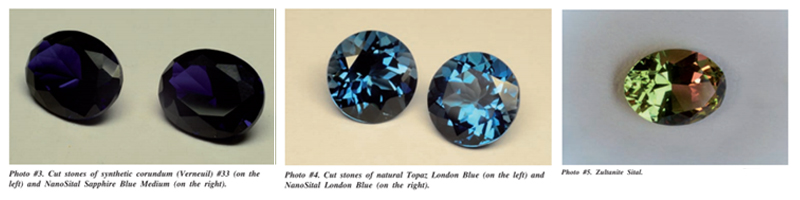
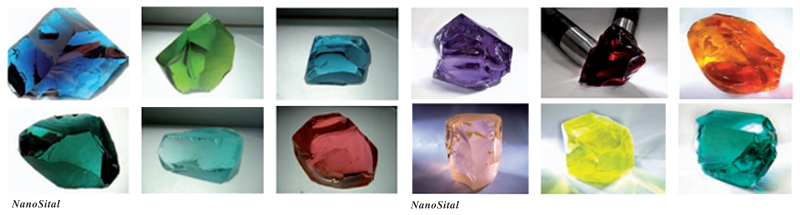
it surely meets the challenge, Photo1 and 2 demonstrate
NANOSITAL raw material of London Topaz colour in comparison
with natural analogues, Photo#3 shows the corresponce
between a well-known gemstone called blue corundum
(#34), and our NANOSITAL ("Blue Sapphire")
Two versions of cut stones are presented in the photo#4.
Those are the natural London Blue Topaz and its NANOSITAL
imitation. It's next to impossible to see the difference
between them. In addition, their densities are also
alomost identical. Today Rusgems offers 50 variety
of coloured NANOSITAL, which would satisty any exacting
taste. For instance, there are imitations of peridot
that reproduct specific details that enable to distinguish
stones obtained from different fields(Pakistan, China,etc).
We can even produce such exotic stone as "Paraiba
Sital or "Zultanite Sital" (Photo #5), which
is very popular at the moment.
Furthermore, Rusgems
is always ready to produce the exclusive stone of
the unique colour using the sample given by a client.
Another special thing about Rusgems is that we are
the only company capable of making colour-change NANOSITAL,
as well as bicolour stones.
Taking market demand
into account, Rusgems products wide range of colours
of quartz group, It has recently become possible to
use the so-called "wax casting" technology
for such popular colours as citrine, smoky and green
quartz, etc.
It is important to note
that NANOSITAL has good optical properties. Its gloss
corresponds to that of the most attractive natural
stones, namely sapphire, ruby and topaz, which becomes
especially apparent when medium and large stones are
viewed. Comparison of NANOSITAL with any other nanomaterial
(photo#6) reveals advantages of the former, since
the latter is hararcterized by cloudiness and cheapglass
glare.
To sum it up, Rusgems
has created a unique material with unrivated charactistics.
It keeps all the best features of its prototype (colour,
purity, glass and beauty), leaving drawbacks (processing
difficulities unstable colour, and most important
-high price) behind.
During these ambiguous
times we all have to make bold and innovative business
moves. That's why right now is the best time to bring
into the world our new material refined with your
jewellery design.
|
|
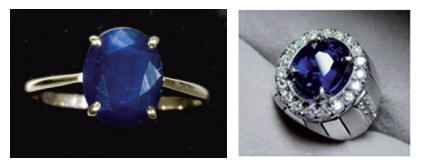
| Blue
Sapphires Are the Top Coloured Stone |
|
What
explains America's enduring love affair with the blue
sapphire? Evan Caplan , president of Evan Caplan fine
coloured gemstone dealers in Los Angeles sums up the
appeal simply" "It's one of the most beautiful
stones in the world, "He rates the blue sapphire
as "definitely number two in sales, right behind
diamonds . "Most of Caplan's sales are in the U.S.
and blue sapphires represent 30 percent to 40 percent
of his buisness by dollar value.
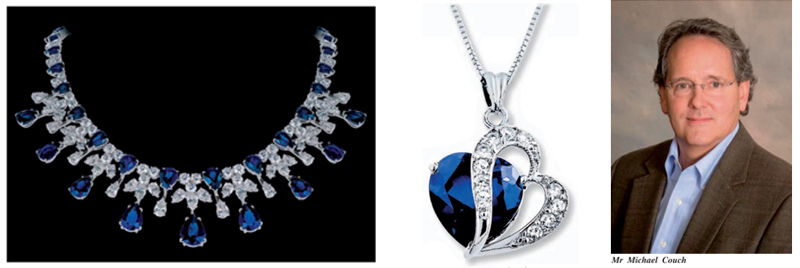
For Michael Couch & Associates
in WIndsor Heights Iowa, the percentage is even higher.
"Blue sapphires represented 60 percent of my sales at
the JCK show , " Glenn Preus, owner of Glenn Preus,
Ltd. is Honolulu, Hawaii, and a specialist in precision-cut
natarul colour Burmese, Ceylon and African Gemstones,
concurs. Blue sapphire is the number-one selling gemstone
in the past five years."
Eddie Livian, president of Atlantic
Gem Corp. in New york City, says that "Blue sapphire
is one of our specialties and yes. AMerican do love
them. Now 99 percent of my business is in the U.S. and
70 percent of that is sapphires. This has probably been
my strongest year." Those would be heated stones,
10 carats and up, at $4,000 to $6.000 per carat. And
99 percent of all sapphires are heated, he say to enhance
their colour.
Kashmir blue sapphires are the
most coverted, for the deep, velvety texture of thier
colour, They are also rare, given the Himalayan source
region has largely been mined out. New world auction
records forsapphires, both set at Sotheby'sGeneva in
November 2013, are $8.3 million for a pair of diamond
and unheated Kashmir sapphire earrings and, In second
place, $7.2 million for a single unmounted 114.74 carat
unheated Burmese sapphire. Burma, Sri Lanka and Madagascar
now supply most of the U.S. blue sapphires market. |
|
| Blue
sapphires benefit from cost appeal when compared with
rubies. Executive Order 13619, signed by President Obama
in August 2013, renewed the ban on importing Burmese
rubies, making them rare and therefore very expensive,
"A fine quality 10 carat ruby cannot be found for
under a couple hundred thousand dollars," Livian
says,"A 10-carat sapphire will cost $30,000 to
$50,000 per stone" |
|
Allure of Blue
Certainly, colour
quality is crucial to the allure - and cost - of the
blue sapphire, "In blue sapphire, purity -as in
no secondary colours - of the primary blue hue is crittical,"says
Preus. "While a vivid, intense, fully saturated
blue of medium dark tone would, by many, be considered
ideal, if that same saturated blue colour green , the
value would be greatly lessened. Saturation in blue
sapphires is often masked by grey overtones, which drives
down the price," The decrease is hard to precisely
quantify, but Preus estimates it as between 30 percent
and 40 percent. |
That blue remains the queen of the sapphires
is evidenced by the prices the stone commands.
"Generally speaking, a red-orange sapphire
will run 75 percent of the price of a blue stone,
"says Couch, "Purple will run 60 percent;
yellows, 40 percent and darker orange, 35 percent."
Preus explains blue
is popular because "it's nature's way of
signalling 'health,' Blue skies, blue ocean...
It's all around us. I think humans have a visceral
reaction to blue, both men and woman. We are
hardwired to cherish this healthy colour". |
|
|
Notable Stones
Attemping to explain
the enduring popularity of the stone, famous. There's
Princess Diana's blue sapphire engagement ring. Consider
also Liz Taylor. She not only owned a Bulgari Sautoir
necklace with a 52.72 carat blue sapphire as its centrepiece
- it sold for almost $6 million at a Christie's auction
in 2011 - she even launched a fragrance line called
" Diamonds and Sapphires" in 1993.
There is also its fashion
appeal, "Blue sapphires, with their endless range
of blue tones, from a jazzy pastel to endlessly rich
intense royal blues, complement a woman's fashion
choices and do not compete with those choices,"Preus
explains.
Shaun Ajodan, president of
Shaun Gems International of New York City, status
that the fashion appeal extends to men, "If you
think of the ties in your wardrobe, which one are
you most likely to wear? The blue tie", Asked
what specific buyers are looking for in a blue sapphires,
Ajodan says,"European want medium cornflower
blue. In the Far East, they want royal blue, In the
U.S., they want good value,"
|
Prices Trending Up
But that value is
becoming more expensive. According to Couch, blue
stones smaller than 1 carat have risen 15 percent
in price in the past year, and 35 percent in the past
three years. Stones 1 carat to 3 carats are up 40
percent in the past year for blues, and 25 percent
for othercolours. CHinese buyers represent 50 percent
of this increased price pressure." They come
in with hundred dollar bills and don't even want a
receipt," Couch says,"Chinese clientele
are playing top dollar. They are looking for Kashmir
blue, cornflower blue,"Despite the price hikes,
dealers remain confindent that the love affair with
sapphires will continue. "Definitely," says
Caplan. "It's a beautiful stone, and realistically,
everything has gone up. So there's no doubt in my
mind that sapphires will return the number-twoselling
stone." |
| |
|
|
|
|