|
|
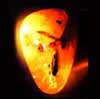
There is absolutely nothing like being part of a good blockbuster hit Hollywood movie to raise one’s profile. It certainly worked for amber. As the vault that contained the precious prehistoric DNA of long extinct dinosaurs in the movie Jurassic Park, It captured the public imagination more effectively than a million dollar advertising campaign would have and why not? After all, it was the main premise that a hundred and thirty million dollar film was based upon.
Actually, this is not amber’s first flirtation with popularity as a gem but more about that later. Let us instead take a look at the genesis of amber. Amber may be called the slowest forming gem, taking literally millions of years to metamorphose from a glob of resin to a gem. And here comes the first of a set of surprises, amber is not even a gem. Let us clarify that by saying that it is not considered a gem by the scientifically oriented as it is an organic material and not a mineral with specific physical properties.
|
 |
|
Indeed, even its chemical composition is highly variable. Over the years many chemical definitions have been published but none accepted as correct. The range of chemical definitions goes something like this: C10H16O12 or C12H20O13or C12H20 or C40H64O14 or C10H16O. The wild swings in the values of the individual elements, is ample indication that this is not a reliably quantifiable compund. What is certain though is that it is composed of carbon, hydrogen and oxygen, the very elements of life. |
 |
|
What must be present in this fossillised resin to qualify it as amber though, is succinic acid. The quantity of the acid present in the chemical make up varies according to the region of occurrence and the type of material but without its presence, it is called retinite and not amber.
|
Where is amber found?
The world's two current sources of amber are the Baltic region and the Dominican Republic. That is not to say that amber is not found elsewhere. The earliest record of amber being used or possessed by humans comes from France and other south European countries.
|
 |
|
The Baltic region became a major source after the ice age when the glaciers thawed and retreated. It existed or was found on the East Anglia coast of England. Amber or copal is also found in the USA, Canada, Mexico, Germany, Romania, the Middle East, Russia, Brazil, South East Asis, New Zealand and in Paris of Africa as well.
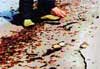
Amber is found on the beachs of the Baltic coast |
How is amber formed?
As mentioned earlier, amber is the resin exuded by some species of prehistoric trees. This resin was formed in special resin canals and is not to be mistaken with the sap, which is a watery substance containing complex sugars (think maple syrup).
It is believed that this resin was formed for one or more or five possible reasons : as a defense mechanism against fungal or insect attack, a by-product of some form of the growth process, a form of dessication control via the resin covering of leaves and bark, an aid to reproduction and the attraction if insect pollinators or a reaction to strom or weather damage.
|
 |
|
These are however just theories and the reason for the production of the resin that finally became amber is not conclusively known. The most popular theory is the one that says the resins is produced as a reaction to insect or fungal attacks. It is also beleived that very few potential amber forming forests remain so even if humans persist in surviving another 100 million years or so, there will be no amber for them to enjoy.
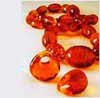
Set consisting of a faceted necklace in big oval amber beads and Creole-shaped earrings
|
|
How exactly does amber form? When the resin was initially exuded, it was most likely soft and tacky. It then undergoes two significant steps, each of which lasts millions of years and involves changes in its molecular structure, before it can become amber.
|
|
|
The first step is the beginning of the polymerisation of the resin, when the molecules begin to cross chain link and form stronger bonds. This results in the hardening of the resin but it has still not reached its amber state . At this point, if it is rubbed vigourously, a smell of resin will be prevalent due to the presence of many volatile oils that are still present in the form of turpenes. At this stage, the resin is called copal. The second stage involves the evaporation of volatile oils still trapped within the resin.
|
|
There is another condition necessary for the transformation of resin into maber and that is an anaerobic environment. The absence of oxygen for most, if not all, of the time that the resin is metamorphosing into amber is absolutely vital to the transformation process. This is because, when oxygen comes into contact with the fossillising resin, it oxidises the surface and corrodes it until eventually, nothing but fragments remain, sort of like how iron oxidises into rust and eats away the metal completely. In most cases this anaerobic environment has been achieved by immersion in sea water as is evident in the case of Baltic and Dominican Republic amber.
|
 |
|
This is basically a very simplistic explanation of how amber forms. Although we have described this process in a nice and linear fashion, the truth is that it is variable depending upon circumstance and environment and is a lengthy process that takes millions of years, undergoing many molecular changes in its transformation from liquid to jewel.
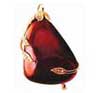
Large, quite rare amber gem coming from the river Simeto in Sicily, set in a brooch of gold and diamonds. |
How do inclusions get into amber?
As mentioned earlier, the main premise in Jurassic Park is the extrasction of dinosaur DNA from a mosquito trapped in amber. Inclusions in fact, are one of the most fascinating aspects of amber. Some of these which include plants and insects usually, seem to have been formed yesterday but in reality may be more than a 100 million years old. How does this happen?
As noted above, amber starts in a viscous liquid state and is probably a defense mechanism of the plant that exudes it. We can conjecture how an insect or a leaf or a blade of grass comes ti be trapped in a drop of this thick gluey liquid. Sometimes, the type or form of amber can tell the story of how the inclusion came into being. Is the inclusion in a single drop or in what seems to be layers? A drop of resin fall on the ground and encases a prehistoric blade of grass or animal hair or a leaf.
|
 |
|
Another scenario could be that the resin is slowly dripping its way down the bark of the tree and an unfortunate insect or lizard happens to alight on it and finds its delicate legs firmly stuck in the slowly hardening adhesive stuff. As the insect struggles, another drop falls over it and mires it more deeply and thus, in layers, the insect is entombed.
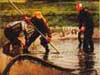
Amber extraction by hydraulic methods from fossil beaches in the region of Zulawy. |
|
Then there are fossillised imprints. When the resin hardens, the process starts from the outside and moves in, meaning that it forms a skin on the outside even while the interior is still soft. A small animal's footprint or a bird'a claw tracks would leave a permanent impression on the resin as it hardens into amber.
|
 |
|
Again, just because an animal or plant has been entombed in the resin, it is not necesssry that it will wind up completing its journey to amber. The resin has to remain intact adn it has to find all the conditions favourable to its transformation into a gem. If these conditions are met, then the body inside undergoes the process of dessication, that is ia gives up all its water adn dries out completely. If there are no fractures or cracks to allow in any air, it is possible for even the delicate internal organs to survive intact.
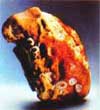
Amber pebble fished out of the Baltic together with fragments of barnacle skeletons
|
Why are the inclusions valuable?
Undoubtedly, the film Jurassic Park sparked a universal rebirth of interest in amber with inclusions in it, but its true importance lies in the fact that it is a time capsule and gives historians, entymologists and other scientists a clue to the kind of organisms that existed millions of years ago.
Speaking of amber and Jurassic Park, there is a noteworthy point that scientists have pointed out and that is that the film makes a mistake in saying that the dinosaur DNA containing amber is from the Dominican Republic, as the amber there is only between twenty to forty million years old and the last dinosaur actually became extinct sixty five million years ago.
|
 |
|
Nevertheless, amber with inclusions suddenly became big business again and faking inclusions rich amber simultaneously became a thriving cottage industry as well. Actually, faking inclusions in amber has been done since early times and was definitely going on in the nineteenth century.
|
|
It peaked in the early 1900's with a lot of the activity being conducted in New Zealand. That is because New Zealand's North Island has large deposits of Kaori gum and this was used to imitate amber. The Kaori gum was gently melted and an insect was placed within it so that when it hardened it had the appearance of included amber.
|
 |
|
Another ingenious method uses true amber, from which a section is sawn off and the main body is drilled and a live insect is placed in the cavity. Molten resin is poured in to cover the insect and then the sawn piece is replaced and seamlessly glued back with the same molten resin. It is not unusual to find plastic that has been passed off as amber, nor is this a recent phenomenon either. Some years ago, the British Natural History Museum learned to its acute embarrassment that a fly preserved in amber and thought to be the oldest of its species was no more than 150 years old. |
Properties
Despite its name, the gem is not always amber in colour. It occurs in more than 250 shades of different colours like milky white, red, blue and even green. Mostly, colour is described by turbidity and hue. Turbidity is the extent to which a specimen is clear or cloudy. Hue of course, is the colour and shape that is apparent. A rule of piece, the closer it is to white.
|
 |
|
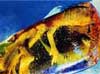
Thanks to its property of being a powerful dessicant (drying agent), it has been speculated that it might have been used by the Egyptians in the mummification process. Indeed, because of the presence of dead insects amber was associated with death and funeral rituals in ancient times and many of the figurines carved from amber relate either to death, rejuvenation or fertility.
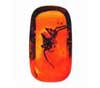
Amber with a gecko inside
|
As mentioned earlier, amber is a natural plastic and has no fixed chemical composition since it is an organic material and not a mineral. Therefore, its physical properties also show great variance. On Moh's scale, amber's hardness lies between 1.5-2.5. This quantity varies according to origin and type. Some Baltic amber may even be as low as 1 on Moh's scale.
|
 |
|
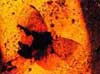
Amber's refractive index is 1.54 and this value is fairly constant, regardless of type and geographical origin, which is a great blessing to those who have to photograph it. Sometimes, an inclusion may appear distorted thanks to the curvature of the host gem. In such cases, all the photographer has to do is immerse the piece in a liquid with the same refractive index and voila, problem solved.
Beautiful flying balm-circket, with its four large wings fully open. |
Since it does not possess a crystalline structure, amber does not have a cleavage and fractures conchoidally. Therefore, it is not an easily facetable gem. Not all specimens are homogenous. Sometimes the amber has formed in layers and is called shelley amber. In other cases, it has dripped down to form stalactites and this is called massive amber.
|
 |
|
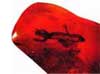
It has a specific gravity of 1.05-1.10, which is relatively low. Amber floats in heavily saturated salt water, Although it does not floats in sea water, it rolls or moves easily with the lightest movement of the sea, provided of course that it is loose. Some frothy amber can have a specific gravity that is as low as 1.
Exceptional finding of a vertebrate included in amber: a small gecko
|
The Greek name for amber is elektron, from which derives the modern word electricity. This is due to a property of amber which releases a static charge when rubbed vigourously with a soft cloth. Amber is a poor conductor of heat and therefore, regardless of external temperatures, always feels warm to the touch.
|
 |
|
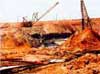
It is thought that the name amber derives from the ambergris, which has nothing to do with amber. It is a product found in the digestive tract of sperm whales and is thought to be a defense reaction against infection caused by the stings of its favarite food, the giant squid. It is found in pieces wached up on beaches or was cut from whales when whaling was a legitimate industry. It is mainly used as a fixative in the perfume industry.
Coastal Amber open-castin mine in Sambia |
| |
|
|
| |
|
|
|
|







 Amber
The Jurassic Gem
Amber
The Jurassic Gem